

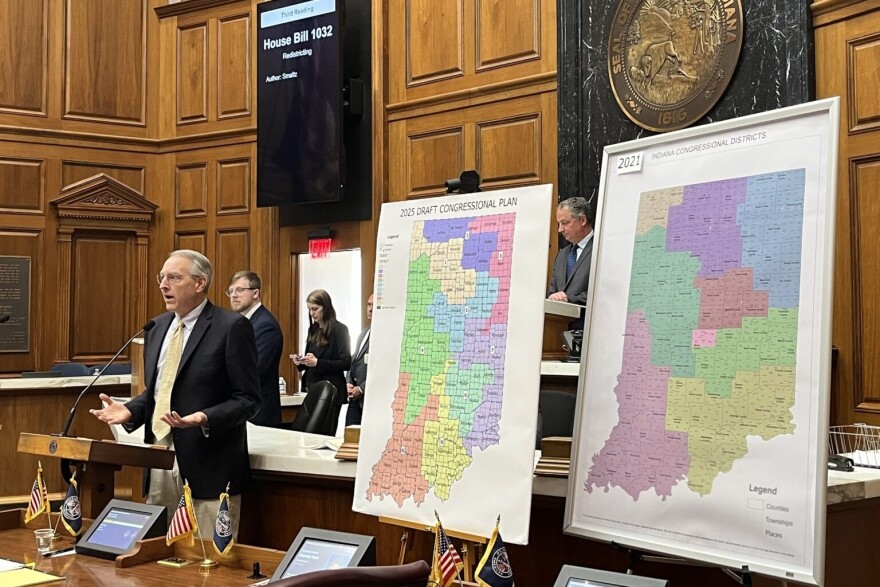
Republican lawmakers in Indiana have unveiled a sweeping redistricting proposal that could dramatically alter the state’s political landscape by eliminating several Democrat-held seats. The plan, introduced during a special legislative session, has triggered intense debate over political fairness, partisan advantage, and the long-term consequences for voter representation.
According to GOP leaders, the proposed map is designed to “modernize district lines” and reflect changes in population patterns. However, Democratic officials and independent analysts argue that the redistricting strategy is a clear attempt at consolidating Republican power by weakening Democratic strongholds—particularly in urban and suburban areas where the party has traditionally maintained significant support.
Under the new proposal, several districts that reliably elect Democrats would be redrawn and merged with larger, more conservative regions. This shift could effectively wipe out multiple Democratic seats in both the state legislature and congressional delegation. Early projections show that Democrats may lose at least two to three key legislative districts, dramatically shrinking their influence in state policymaking for years to come.
Political experts note that strategies like this are part of a broader trend in U.S. politics, where states controlled by one party increasingly leverage redistricting to cement long-term electoral advantages. Indiana, where Republicans hold a supermajority, represents one of the clearest examples of partisan map-drawing aimed at reshaping representation rather than simply adjusting district boundaries based on population data.
Democratic lawmakers have sharply criticized the proposal, calling it an “undemocratic power grab.” They warn that the new map would distort voter representation by weakening communities where Democratic voters are concentrated. Some advocates argue that the redistricting effort could dilute the voices of minority voters, who tend to reside in compact urban districts now being split or absorbed into heavily Republican regions.
Voting rights organizations are already evaluating potential legal challenges, stating that the proposal may violate principles of fair representation. While the map might technically comply with population equality requirements, opponents argue that the intent and the impact of the plan raise constitutional concerns. Court battles over gerrymandering have become increasingly common across the country, though legal precedents remain complex and often favor state legislatures.
Republican leaders, however, defend the proposal as a routine administrative necessity. They argue that population shifts require adjustments, and claim the map was drawn using standard geographic and demographic criteria. They also dismiss accusations of partisan motives, saying Democrats are attempting to “politicize a straightforward process.”
If approved, the redistricting plan could reshape Indiana politics for the next decade. With fewer Democratic districts, policy debates—ranging from education and healthcare to taxation and social issues—would likely tilt even further toward conservative priorities.
As public hearings continue, community members, civic groups, and policy analysts are urging transparency and public engagement. The debate over this proposal is expected to intensify, setting the stage for one of the most consequential political fights in Indiana’s recent history.
Watch video below :


