

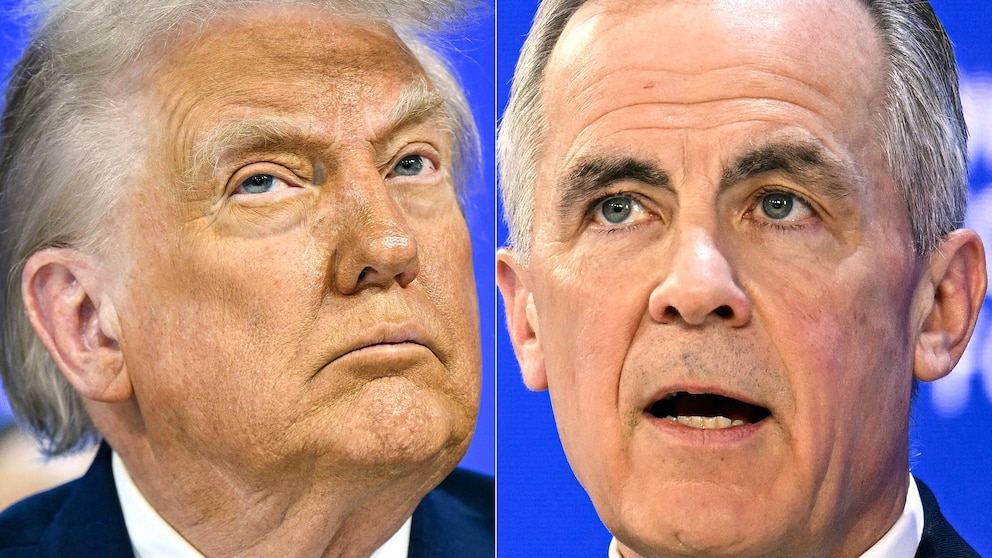
U.S. President Donald Trump has issued a sharp warning to Canada, threatening to impose 100% tariffs on Canadian goods if Ottawa moves forward with a major trade or economic deal with China. The statement has quickly drawn international attention, raising concerns about escalating trade tensions in North America.
Speaking during a public appearance, Trump criticized Canada for what he described as “aligning economically with China,” which he has long accused of unfair trade practices and strategic manipulation of global markets. He argued that any agreement between Canada and China could undermine U.S. economic and national security interests, particularly if it involves sensitive industries or supply chains.
“If Canada makes a deal with China, they should expect massive consequences,” Trump said, adding that tariffs of up to 100% would be considered if he were in a position to act. The comments reflect Trump’s continued hardline stance on China and his willingness to use tariffs as a primary economic weapon.
Canada is one of the United States’ largest trading partners, with billions of dollars in goods crossing the border each year. Industries such as automotive manufacturing, agriculture, energy, and technology are deeply integrated across the two economies. Any move toward extreme tariffs could significantly disrupt supply chains, raise consumer prices, and strain diplomatic relations.
Canadian officials have not confirmed any finalized trade deal with China but have acknowledged ongoing discussions aimed at diversifying trade partnerships. In recent years, Canada has sought to reduce its reliance on the U.S. market by expanding economic ties in Asia, including with China, despite political and human rights tensions.
Trade experts warn that the threat of 100% tariffs would represent an unprecedented escalation in U.S.–Canada trade relations. “Such tariffs would effectively shut down large portions of cross-border trade,” one analyst said. “The economic fallout would be felt immediately on both sides of the border.”
Trump’s remarks also highlight a broader geopolitical struggle, as Western nations reassess their economic dependence on China. The United States has increasingly pressured allies to limit cooperation with Beijing in areas such as technology, infrastructure, and critical minerals. Trump has argued that allies should choose economic alignment with Washington rather than Beijing.
Critics, however, say the president’s comments risk destabilizing relationships with close allies. Some economists note that aggressive tariff threats could backfire, prompting retaliation and weakening regional economic stability. Others argue that Canada, as a sovereign nation, has the right to pursue independent trade policies.
The warning comes amid renewed speculation about Trump’s future political ambitions and his influence on U.S. trade policy debates. During his presidency, Trump imposed sweeping tariffs on China, Canada, and other trading partners, reshaping global trade dynamics and sparking multiple trade disputes.
As discussions about global trade realignments continue, Trump’s tariff threat underscores how fragile international economic relationships remain. Whether Canada moves forward with deeper economic engagement with China or seeks to avoid confrontation, the statement has already added new uncertainty to the future of North American trade relations.
Watch video below :


