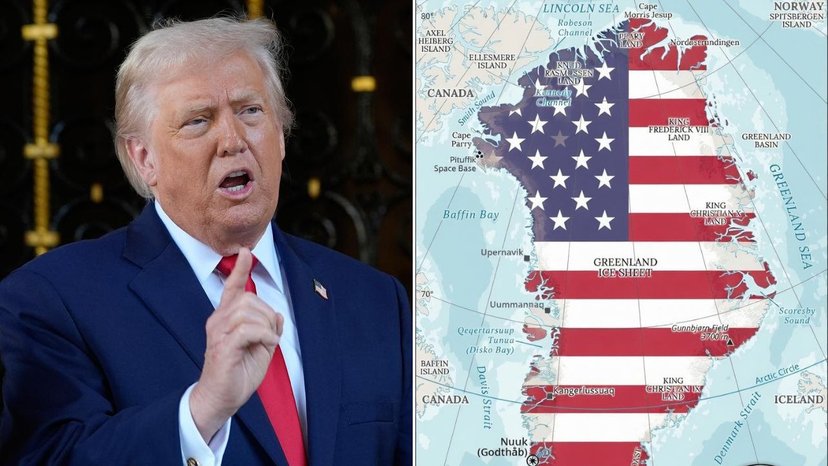
U.S. President Donald Trump has once again stirred global attention after issuing a cryptic warning about how far he is willing to go to acquire Greenland, responding bluntly to questions with the words: “You’ll find out.” The remark has fueled speculation and heightened geopolitical tensions, sending ripples through political and financial circles worldwide.
Speaking to reporters during a recent appearance, Trump declined to clarify whether his renewed interest in Greenland would involve economic pressure, diplomatic negotiations, or other measures. His ambiguous response immediately drew reactions from U.S. allies and European leaders, particularly Denmark, which maintains sovereignty over the semi-autonomous Arctic territory.
Greenland has long held strategic importance due to its vast natural resources, rare earth minerals, and critical location in the Arctic region. As climate change accelerates ice melt and opens new shipping routes, global powers have increasingly viewed the region as a key geopolitical asset. Trump’s comments suggest that Greenland may once again be central to future U.S. strategic planning.
This is not the first time Trump has expressed interest in acquiring Greenland. During his previous presidency, similar remarks sparked diplomatic backlash and were widely dismissed by Danish officials. However, analysts note that the current geopolitical climate — marked by rising competition in the Arctic and growing tensions among major powers — makes the latest comments more consequential.
European officials reacted cautiously, emphasizing that Greenland is not for sale and reaffirming Denmark’s territorial integrity. Nevertheless, Trump’s refusal to rule out aggressive tactics has raised concerns that economic tools such as tariffs or trade pressure could be used to advance U.S. interests.
Market observers are also paying close attention. Recent statements linking Greenland-related tensions to potential tariffs on European countries have already unsettled global financial markets. Investors worry that escalating rhetoric could translate into real policy actions, triggering trade disputes and increased market volatility.
“Uncertainty is what markets fear most,” said one geopolitical analyst. “When a political leader hints at drastic action without details, it forces governments, businesses, and investors to prepare for worst-case scenarios.”
From a strategic standpoint, the Arctic has become an increasingly competitive arena, with the United States, Russia, and China all expanding their influence in the region. Control over critical shipping lanes and access to untapped resources could significantly reshape global power dynamics in the coming decades.
Despite the controversy, Trump’s supporters argue that his approach reflects a tough negotiating style aimed at securing long-term American interests. Critics, however, warn that confrontational rhetoric risks damaging alliances and destabilizing already fragile international relationships.
As questions continue to mount, one thing remains clear: Trump’s statement has reignited debate over Greenland’s future and the broader implications for global diplomacy. Whether his words signal a serious policy direction or strategic posturing, the world is watching closely to see what comes next.
Watch video below :