

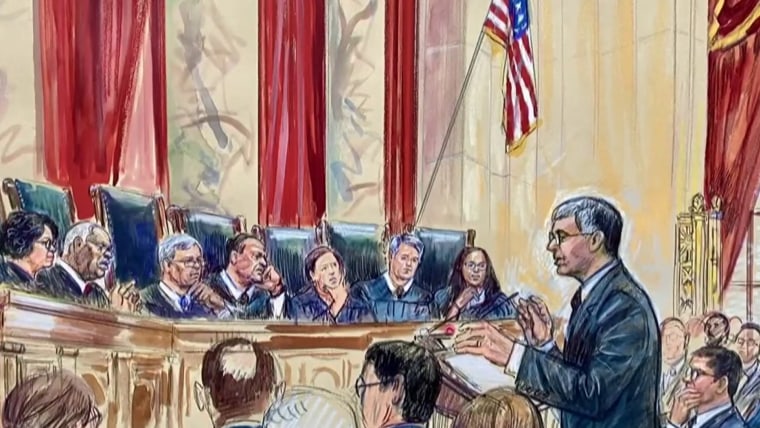
The United States Supreme Court appears poised to deliver a landmark decision that could dramatically expand presidential authority over independent federal agencies. During recent oral arguments, a conservative majority signaled strong support for President Donald Trump in a case challenging long-standing limits on a president’s power to remove officials who lead regulatory bodies. The ruling, expected in mid-2026, could fundamentally reshape the balance of power in Washington and redefine how the federal government operates.
At the center of the controversy is Trump’s removal of Rebecca Slaughter, a commissioner of the Federal Trade Commission (FTC). Historically, FTC leaders — like those in several other independent agencies — have been shielded from dismissal except in cases of “inefficiency, neglect of duty, or malfeasance.” These protections originate from the 1935 Supreme Court decision Humphrey’s Executor v. United States, a precedent that has governed the independence of federal agencies for nearly 90 years. However, multiple justices indicated that they view this precedent as outdated and inconsistent with today’s expansive federal bureaucracy.
During oral arguments, conservative justices questioned whether Congress can constitutionally impose “for-cause” protections that restrict the president’s ability to remove agency heads. Several suggested that independent agencies now exercise significant executive authority, making it inappropriate for them to operate beyond direct presidential control. Their comments strongly imply that the court may strike down or sharply limit the legal foundations of agency independence.
A ruling in Trump’s favor would have immediate and far-reaching consequences. It could validate his removal of FTC leadership and embolden the White House to dismiss officials across other key agencies such as the National Labor Relations Board (NLRB), Consumer Product Safety Commission (CPSC), and Merit Systems Protection Board (MSPB). Critics warn this shift would weaken safeguards designed to prevent political interference in areas like consumer protection, labor rules, financial oversight, and antitrust enforcement.
Supporters of expanded presidential removal power argue that such agencies should remain accountable to the executive branch. They contend that allowing unelected officials to wield broad regulatory authority without direct oversight undermines democratic principles. According to this view, restoring presidential control ensures coherence in policy implementation and transparency in decision-making.
Opponents, however, fear the ruling could politicize regulatory decisions and erode the expertise-driven mission of independent agencies. They warn that critical protections could be dismantled, enabling future presidents to replace experienced regulators with political loyalists.
In the months ahead, legal scholars and policymakers will closely monitor how broadly the Supreme Court chooses to rule. A narrow decision might apply only to the FTC, while a sweeping opinion could dismantle for-cause removal protections across the entire federal regulatory framework. Either way, the case has emerged as one of the most significant constitutional tests of presidential power in decades — with consequences that could shape the federal government long after the current administration.
Watch video below :
:max_bytes(150000):strip_icc():focal(749x0:751x2)/Karoline-Leavitt-Expecting-Baby-No-2-122625-3ee9c9c5c0004741808a746cca98b9b2.jpg?w=350&resize=350,220&ssl=1 "White House Press Secretary Karoline Leavitt Announces Pregnancy, Expecting Baby Girl")





:max_bytes(150000):strip_icc():focal(749x0:751x2)/Karoline-Leavitt-Expecting-Baby-No-2-122625-3ee9c9c5c0004741808a746cca98b9b2.jpg?w=180&resize=180,130&ssl=1 "White House Press Secretary Karoline Leavitt Announces Pregnancy, Expecting Baby Girl")