The Secretary General of NATO faced direct questions about whether the alliance would ever consider allowing Donald Trump to gain control of Greenland, highlighting renewed geopolitical tensions surrounding the strategically important Arctic territory.
The issue resurfaced following recent discussions between Trump and NATO Secretary General Mark Rutte, where Arctic security and the growing influence of global powers such as Russia and China were reportedly key topics. While the question of transferring sovereignty over Greenland was raised directly by reporters, NATO officials emphasized that discussions are focused primarily on regional security cooperation rather than territorial ownership.
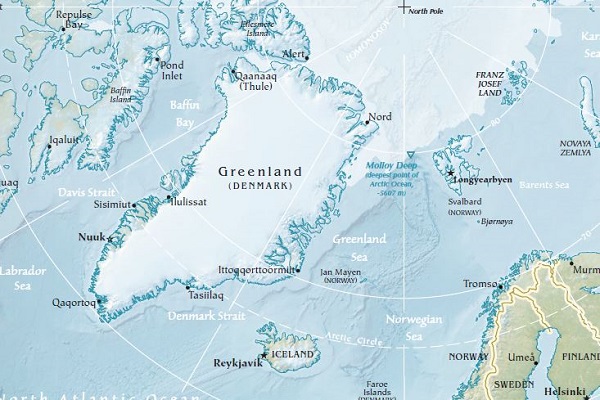
Greenland, a semi-autonomous territory of Denmark, has become increasingly important in global strategic calculations due to its geographic position in the Arctic, an area experiencing rising military, economic, and environmental interest. Melting ice has opened new shipping routes and access to natural resources, intensifying competition among major powers seeking influence in the region.
Trump has repeatedly expressed interest in expanding U.S. involvement in Greenland, arguing that the island plays a vital role in missile defense systems, early warning radar installations, and broader Arctic security infrastructure. Analysts note that the United States already maintains a military presence on the island under longstanding defense agreements with Denmark, reflecting Greenland’s long-standing role in transatlantic security planning.
During recent remarks, Rutte acknowledged shared concerns about increasing activity from Russia and China in the Arctic region, emphasizing that NATO members recognize the need to strengthen cooperation to maintain stability. However, officials stressed that sovereignty issues remain governed by international law and bilateral agreements between Denmark and Greenland’s government.
European leaders have consistently indicated that Greenland is not for sale, reinforcing the importance of respecting territorial integrity among NATO allies. Diplomatic observers suggest that the controversy reflects broader strains within the alliance, particularly as Trump has publicly criticized NATO’s response to recent international conflicts and defense commitments.
The renewed attention to Greenland also comes amid wider debates about burden-sharing within NATO and the strategic importance of Arctic defense infrastructure. Some policymakers argue that closer coordination between allies is necessary to address emerging threats, while others warn that disputes over territory could undermine alliance unity.
Although no formal proposal to transfer control of Greenland has been confirmed, the discussion underscores how Arctic geopolitics has become increasingly central to global security strategy. Experts note that the island’s location between North America and Europe makes it uniquely positioned for surveillance, missile tracking, and maritime operations.
As tensions continue to shape international relations, NATO leaders appear focused on balancing alliance unity with national interests, while avoiding escalation over sensitive territorial questions. The debate surrounding Greenland ultimately reflects broader concerns about global competition, defense cooperation, and the evolving role of NATO in a rapidly changing geopolitical landscape.
Watch video below :