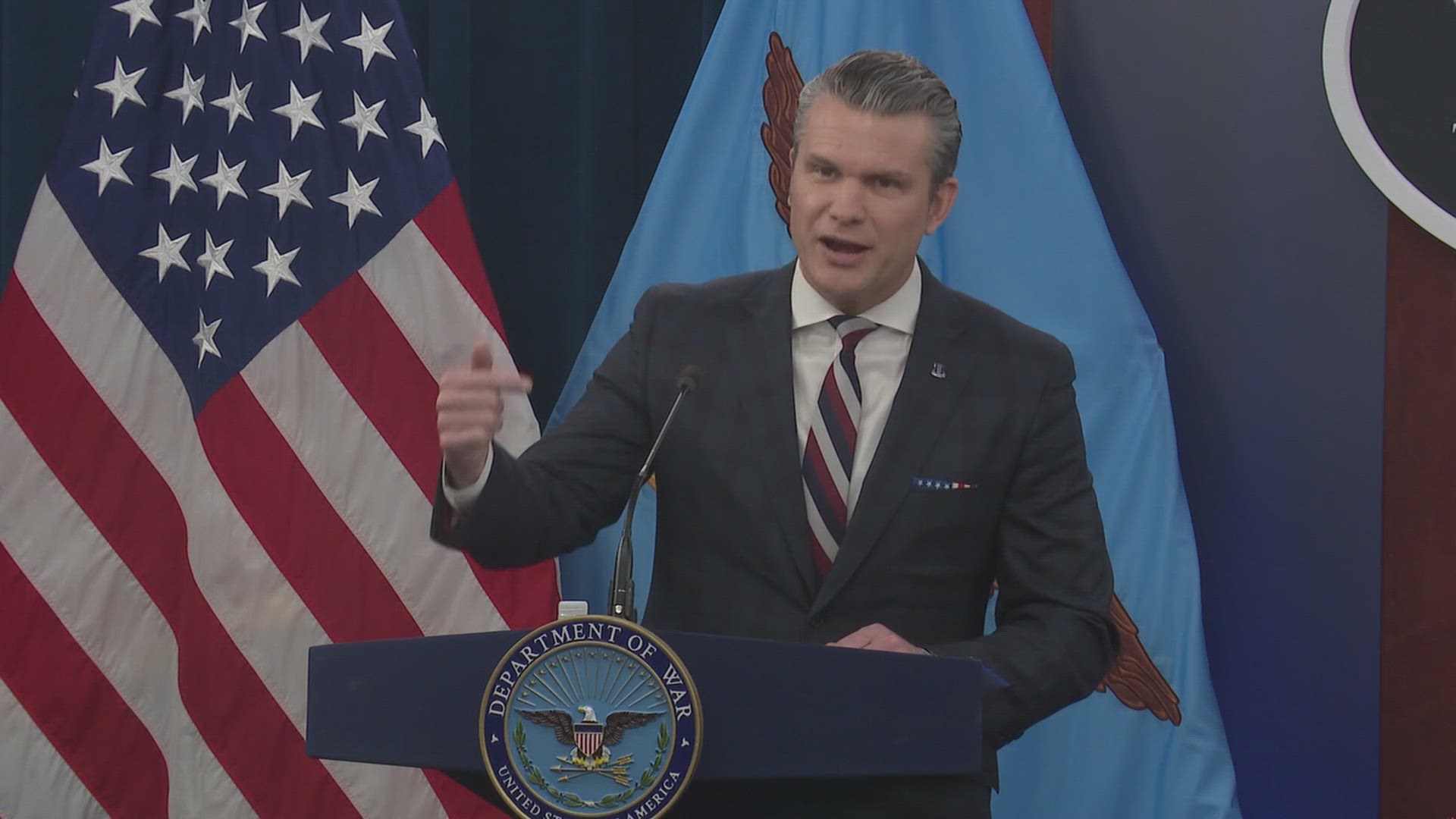
U.S. Defense Secretary Pete Hegseth has acknowledged that while the United States is asserting air dominance in the escalating Iran conflict, it cannot intercept every missile, rocket, or drone launched by Iran. His remarks underscore both American military confidence and the operational limits of modern air defense systems.
Speaking at a briefing at the United States Department of Defense, Hegseth emphasized that U.S. forces have significantly strengthened their defensive posture across the region. Advanced missile defense systems, fighter aircraft, and naval assets have been deployed to counter Iranian retaliatory strikes. However, he cautioned that even the most sophisticated air defense network cannot guarantee 100% interception success.
“We can’t stop everything,” Hegseth stated, while reaffirming that the United States currently holds a decisive advantage in the skies. His comments come as U.S. forces increase air operations aimed at suppressing Iranian capabilities and protecting American personnel and regional allies.
The statement reflects a critical reality in modern warfare: air superiority does not eliminate all threats. Iran possesses an extensive arsenal of ballistic missiles, cruise missiles, and armed drones capable of targeting military bases and strategic infrastructure. Despite American air dominance, some projectiles may penetrate defensive shields, potentially putting U.S. troops “in harm’s way,” as Pentagon officials have warned.
Hegseth’s remarks also serve as a signal to the American public and international observers that military operations carry inherent risks. By openly acknowledging the limits of interception systems, the Pentagon appears to be managing expectations amid rising regional tensions.
The broader Iran conflict has intensified in recent days, with increased aerial engagements and missile exchanges reported across multiple fronts. The U.S. has reinforced air defense batteries and repositioned assets to strengthen force protection measures. At the same time, officials stress that offensive and defensive strategies are working in tandem to degrade Iranian launch capabilities before threats materialize.
Military analysts note that achieving air dominance typically involves neutralizing enemy aircraft and suppressing air defense systems. However, intercepting high-volume missile and drone attacks presents a separate and complex challenge. Even advanced systems such as layered missile defense networks can be overwhelmed if faced with coordinated saturation strikes.
Hegseth’s balanced message — confidence in U.S. military strength combined with acknowledgment of operational constraints — highlights the seriousness of the current geopolitical environment. It also reinforces the administration’s stance that while the United States seeks to maintain control of the battlespace, no defense architecture is impenetrable.
As the Iran conflict continues to evolve, the Pentagon’s strategy will likely focus on sustaining air superiority while mitigating vulnerabilities through enhanced intelligence, rapid response capabilities, and regional cooperation. For now, Hegseth’s statement makes clear that air dominance does not equate to absolute protection — and that risk remains a defining factor in this escalating confrontation.
Watch video below :