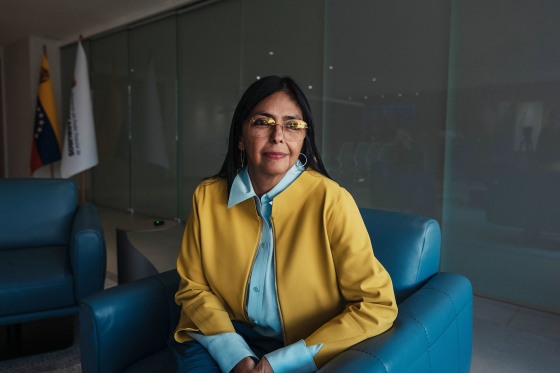
Delcy Rodríguez has emerged as Venezuela’s new leader following the dramatic capture of President Nicolás Maduro, marking a sudden and consequential shift in the country’s political leadership.
Rodríguez, who previously served as vice president and one of Maduro’s closest allies, was formally elevated after senior government officials announced a transitional leadership arrangement. The move was framed as necessary to preserve stability and continuity amid what authorities described as an unprecedented national crisis.
The announcement came shortly after Maduro was taken into U.S. custody during a highly controversial operation that has drawn global attention and condemnation from several governments. With Maduro removed from power, Venezuela’s ruling elite moved quickly to project unity and maintain control over state institutions, including the military, security forces, and key economic bodies.
In her first public remarks as leader, Rodríguez vowed to defend Venezuela’s sovereignty and accused foreign powers of violating international law. She pledged to continue the policies of the previous administration while promising resilience in the face of external pressure. Supporters within the ruling party praised her appointment as a symbol of continuity and resistance.
Rodríguez is a seasoned political figure with deep roots in Venezuela’s power structure. Before becoming vice president, she served as foreign minister and later as a key economic official overseeing sanctions response efforts. Known for her combative rhetoric on the international stage, Rodríguez has frequently criticized the United States and its allies, accusing them of waging economic warfare against Venezuela.
Analysts say her rise to leadership was widely anticipated in the event of Maduro’s removal. “She has long been seen as the regime’s most trusted enforcer and spokesperson,” one regional expert said. “Her appointment signals that the governing structure intends to hold its line rather than pivot politically.”
Opposition figures, however, have rejected Rodríguez’s legitimacy, arguing that her leadership lacks constitutional basis. Critics say the transition reflects internal power consolidation rather than a genuine legal process. Several opposition leaders have renewed calls for internationally supervised elections, claiming the current situation represents an opportunity for democratic change.
International reaction has been mixed. Allies of Caracas, including several countries aligned with Venezuela’s government, expressed support for Rodríguez and emphasized non-interference. Western governments, meanwhile, have questioned the legality of the transition and urged restraint, dialogue, and respect for democratic norms.
Economic uncertainty looms large as Rodríguez assumes power. Venezuela remains under heavy sanctions, grappling with inflation, declining oil revenues, and widespread poverty. Observers say her ability to stabilize the economy and maintain loyalty within the military will be critical in determining how long the new leadership can endure.
Security forces have been placed on high alert across major cities, with authorities warning against unrest and unauthorized demonstrations. Despite the tense atmosphere, large-scale protests have not yet materialized, though analysts caution the situation remains volatile.
As Venezuela enters this new chapter, Delcy Rodríguez faces the challenge of governing a deeply divided country under intense international scrutiny. Whether her leadership brings stability or deepens the crisis will shape Venezuela’s future—and its relations with the rest of the world.
Watch video below :