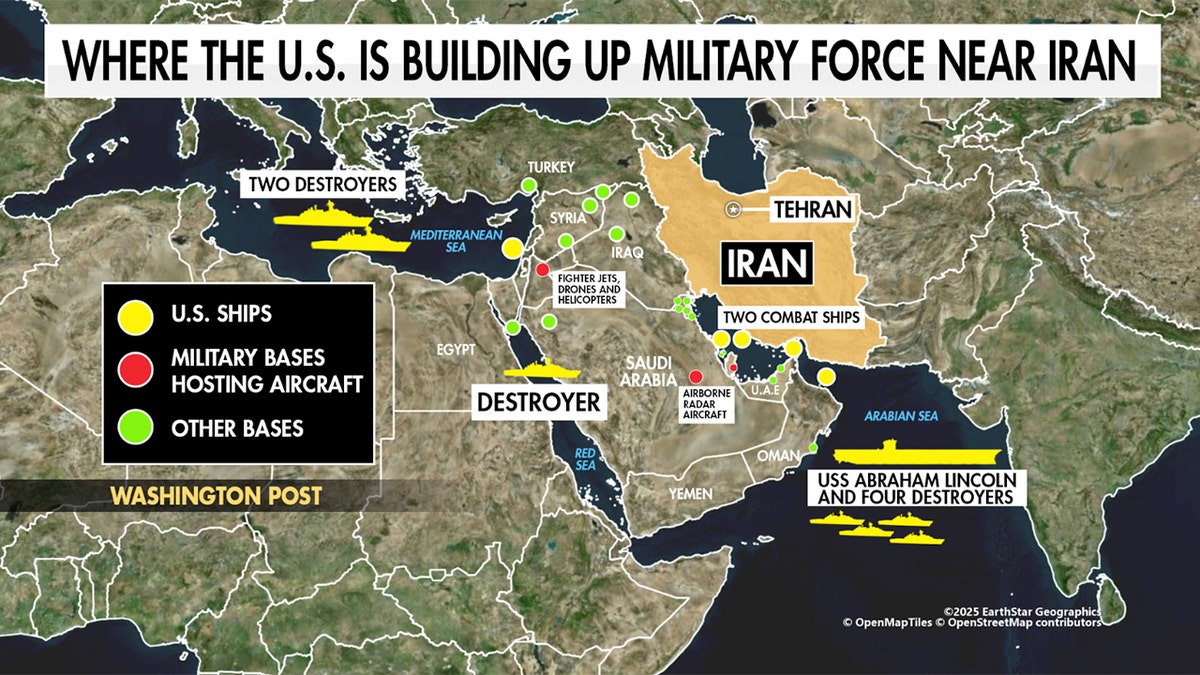
The United States is continuing to expand its military presence near Iran, signaling heightened regional tensions and growing uncertainty over the future of diplomatic negotiations. Defense officials describe the deployment as a strategic move aimed at deterrence, but analysts warn the buildup could significantly increase the risk of confrontation in the Middle East.
Over recent weeks, Washington has reinforced its naval and air assets across key strategic corridors. Multiple warships and support vessels have been positioned in and around the Persian Gulf, while advanced fighter aircraft have been deployed to regional bases. The enhanced military posture is designed to strengthen operational readiness and provide rapid response capability should tensions escalate.
At the center of the standoff are ongoing disputes related to Iran’s nuclear program and broader regional security concerns. U.S. officials maintain that the deployments are defensive in nature and intended to discourage aggressive actions. However, the scale of the buildup represents one of the most significant increases in American military assets in the region in recent years.
The strategic importance of the Persian Gulf and the Strait of Hormuz — critical global shipping lanes for oil and gas — adds further weight to the situation. Any instability in these waterways could disrupt global energy markets and impact economies worldwide. As a result, international observers are closely monitoring developments.
Iranian officials have criticized the military expansion, framing it as provocative and unnecessary. Tehran has reiterated its position that it will not yield to external pressure while emphasizing its right to pursue what it describes as peaceful nuclear activities. Military drills and defensive exercises conducted by Iran have added another layer of complexity to the evolving security environment.
Meanwhile, diplomatic efforts continue behind the scenes. Indirect talks between U.S. and Iranian representatives are reportedly ongoing, though progress remains uncertain. Analysts note that military positioning can sometimes serve as leverage in negotiations, but it can also heighten miscalculation risks if communication channels break down.
Regional allies and global powers have called for restraint. Concerns are mounting that any accidental clash or misinterpreted action could trigger broader instability. Security experts stress that while deterrence may prevent immediate escalation, prolonged military posturing increases the chances of unintended consequences.
The buildup also reflects broader geopolitical dynamics, as global powers reassess their strategic interests in the Middle East. The balance between diplomacy and military preparedness remains delicate, with both sides publicly asserting defensive intentions.
As the situation unfolds, the international community remains focused on whether diplomatic engagement can ease tensions before the expanding military presence translates into direct confrontation. The coming weeks are likely to be critical in determining whether the region moves toward de-escalation — or faces a new chapter of heightened conflict risk.
Watch video below :