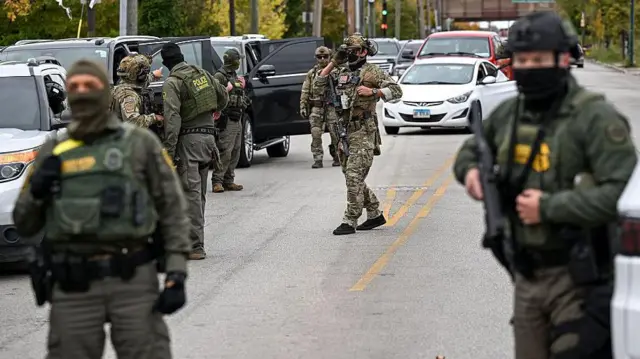
The U.S. Supreme Court has rejected President Donald Trump’s request to deploy National Guard troops in Illinois, marking a major legal defeat and reinforcing long-standing limits on presidential authority over domestic military deployments. The decision leaves in place lower court rulings that blocked the federal government from taking control of Illinois’ National Guard without the consent of state leaders.
The case stemmed from Trump’s attempt to federalize National Guard units to support federal law enforcement operations in and around Chicago. The administration argued that the move was necessary to protect federal facilities and personnel amid heightened tensions related to immigration enforcement. Illinois officials strongly opposed the action, insisting that local and state authorities were fully capable of maintaining public order.
In a brief order, the Supreme Court declined to intervene, effectively allowing previous rulings to stand. Those rulings concluded that the federal government lacked sufficient legal justification to override the authority of Illinois’ governor and deploy Guard troops for domestic law enforcement purposes. While the court did not issue a full written opinion, the outcome sends a clear signal about the judiciary’s reluctance to expand executive power in this sensitive area.
Illinois Governor J.B. Pritzker welcomed the decision, calling it a victory for states’ rights and constitutional balance. State officials argued that the president cannot unilaterally federalize the National Guard unless strict legal conditions are met, such as an actual rebellion or a complete breakdown of civil order. Courts reviewing the case agreed, finding no evidence that Illinois faced such circumstances.
Trump’s legal team had relied on federal statutes that allow the president to deploy military forces domestically in limited situations. However, judges at multiple levels found those laws did not apply to the situation in Illinois. They emphasized that the National Guard traditionally operates under the command of state governors and that federal intervention must meet a high legal threshold.
The Supreme Court’s refusal to take up the administration’s appeal underscores the importance of checks and balances when it comes to using military forces on U.S. soil. Legal experts say the ruling reinforces the principle that domestic law enforcement is primarily a state and local responsibility, not a federal military function.
The decision also carries broader political implications. Trump has frequently advocated for a tougher federal response to protests, immigration enforcement challenges, and urban crime. Critics warn that using the National Guard or military forces in such contexts risks escalating tensions and undermining civil liberties.
Although several conservative justices dissented, arguing that the president should retain flexibility to protect federal interests, the majority allowed the lower court restrictions to remain in effect. The outcome limits Trump’s ability to pursue similar deployments in other states without clear legal authorization or state cooperation.
As debates continue over immigration, public safety, and executive power, the ruling stands as a significant precedent. It clarifies that presidential authority over the National Guard is not absolute and must operate within constitutional and statutory boundaries. For now, Illinois retains control of its Guard, and the Supreme Court has drawn a firm line on the limits of federal power at home.
Watch video below :