

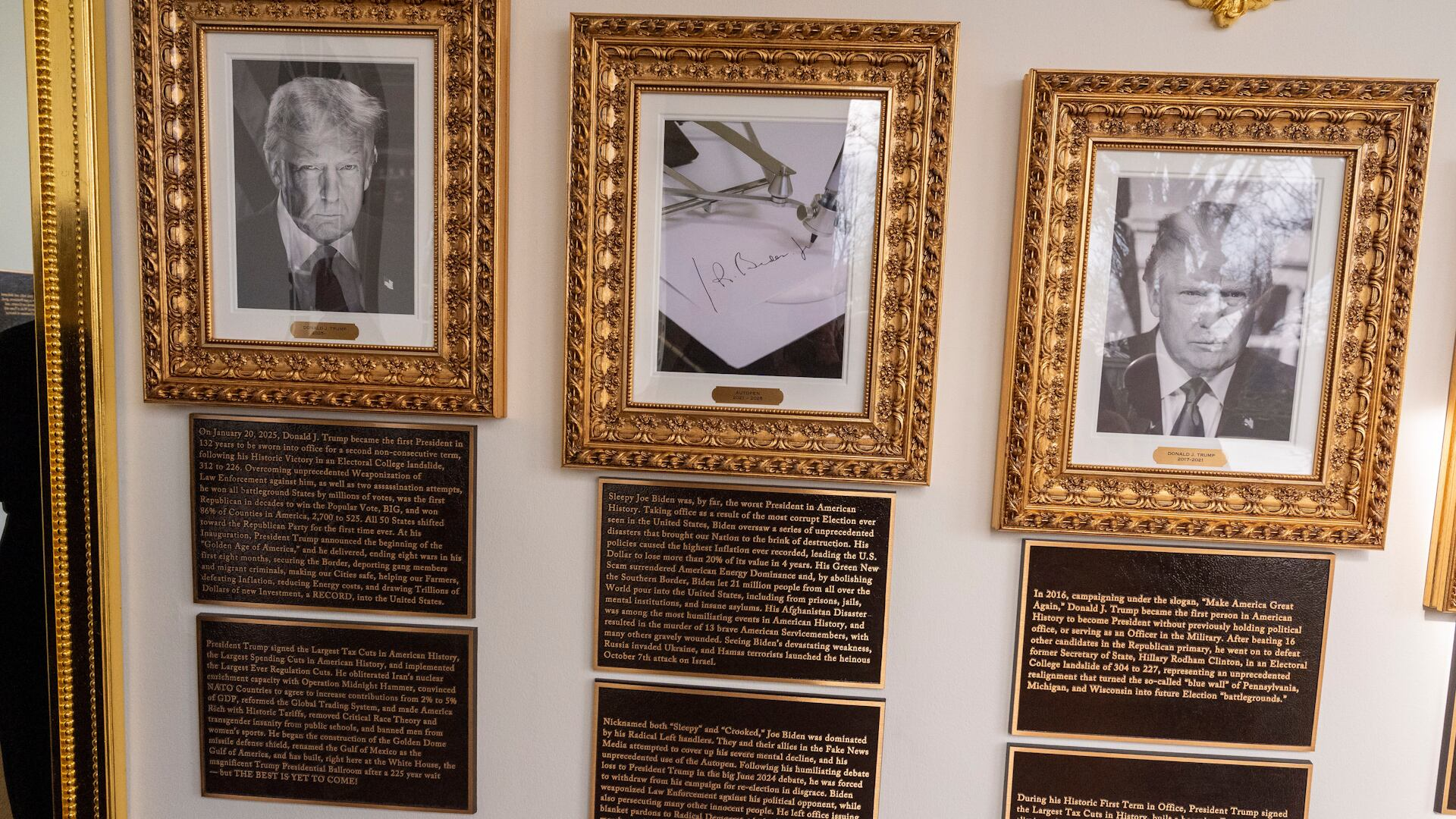
Donald Trump’s newly installed plaques have triggered a fierce national debate, raising a provocative question: Are they a genuine tribute, a calculated act of trolling, or an attempt to rewrite history?
The plaques, unveiled amid little advance notice, are intended to provide historical context and interpretation tied to Trump’s presidency and legacy. Supporters describe them as long-overdue recognition, while critics argue they reflect a selective version of events that downplays controversy and amplifies favorable narratives.
At the center of the controversy is how history is being framed. The language on the plaques emphasizes achievements, leadership, and policy milestones, portraying Trump’s time in office as a period of strength and decisive action. Opponents argue that the wording glosses over deeply polarizing moments, including impeachments, social unrest, and challenges to democratic norms.
For Trump’s supporters, the plaques are a symbolic tribute, asserting that his presidency has been unfairly judged by political opponents and hostile media. They see the move as an effort to balance what they believe is an already biased historical record. From this perspective, the plaques serve as a corrective — ensuring Trump’s legacy is not defined solely by criticism.
Critics see it very differently. Some argue the plaques are a form of political trolling, designed to provoke outrage and dominate headlines rather than foster thoughtful historical reflection. They point out that Trump has long used controversy as a communication strategy, and that the backlash itself may be part of the intended effect.
Others go further, warning that the plaques represent an attempt at rewriting history. Historians and cultural commentators caution that public displays carry authority and permanence, shaping how future generations understand the past. When complex events are reduced to simplified narratives, they argue, nuance and accountability are often lost.
The debate also highlights a broader cultural struggle over who controls historical memory. In an era of deep political division, monuments, plaques, and exhibits have become battlegrounds for competing interpretations of national identity and leadership. Trump’s plaques fit squarely into this trend, blurring the line between commemoration and political messaging.
Social media reaction has been swift and polarized. Supporters praise the plaques as bold and unapologetic, while critics describe them as misleading or self-serving. The controversy has reignited calls for clearer standards on how political figures are represented in public institutions and historical spaces.
Ultimately, whether the plaques are viewed as tribute, trolling, or historical revision depends largely on political perspective. What is undeniable is their impact: they have reopened debates about Trump’s presidency, the role of public history, and how power influences collective memory.
As the argument continues, one thing is clear — the fight over Trump’s legacy is far from over, and even seemingly simple plaques can become powerful symbols in America’s ongoing struggle over truth, history, and interpretation.
Watch video below :


