

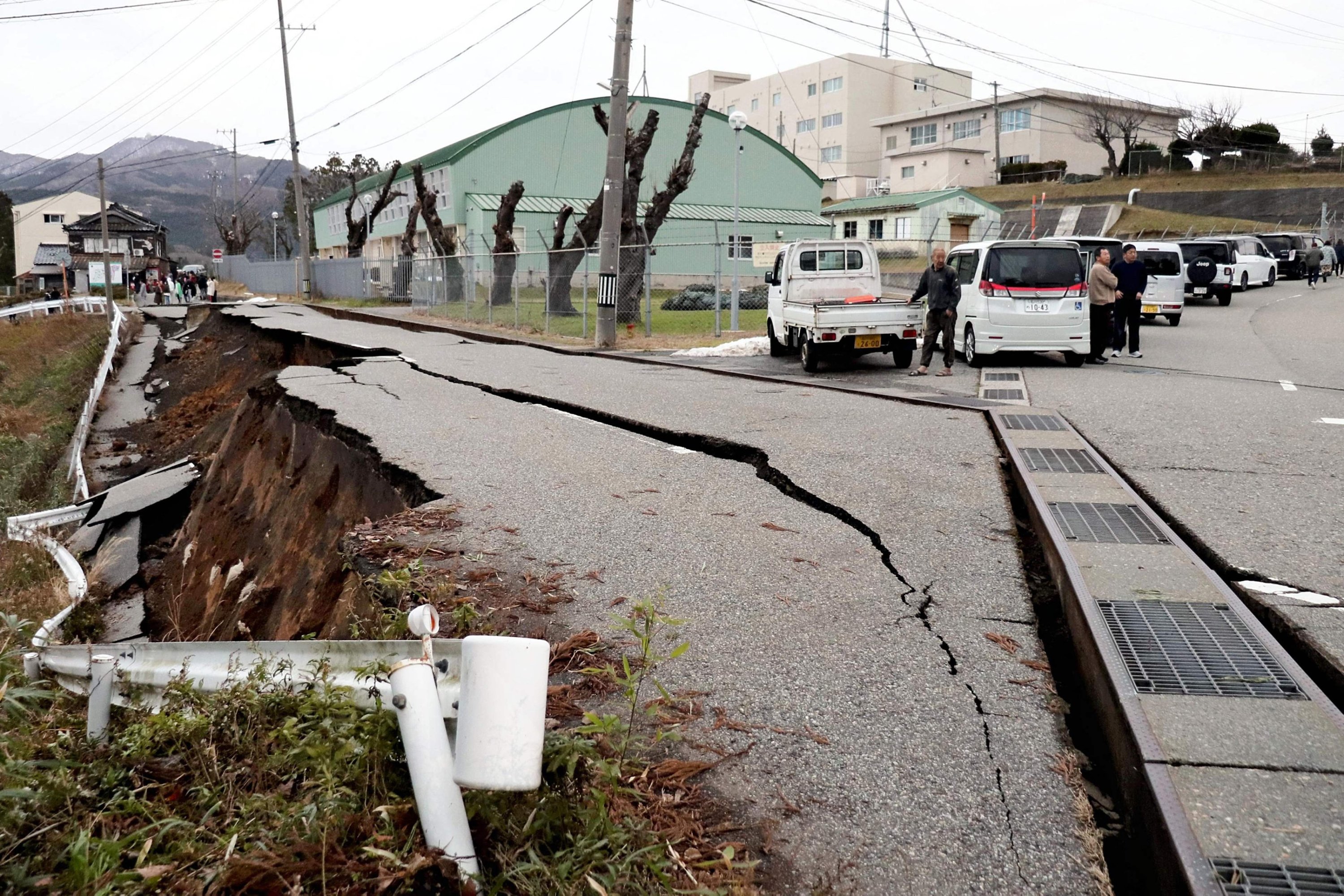
A powerful 7.5-magnitude earthquake struck off the northeastern coast of Japan late Monday, sending shockwaves across multiple prefectures and prompting widespread tsunami warnings. The Japan Meteorological Agency (JMA) reported that the quake’s epicenter was located roughly 80 kilometers offshore near Aomori Prefecture, at a depth of around 50 to 55 kilometers — strong enough to generate intense shaking across coastal communities.
The quake hit at approximately 11:15 p.m. local time, rattling buildings, triggering alarms, and causing immediate panic in cities such as Hachinohe, where the tremor intensity reached an “upper-6” on Japan’s shindo scale. This level of shaking is capable of knocking over large furniture, damaging structures, and causing significant injuries. Residents described the ground shaking violently for several seconds, with many rushing outside despite cold temperatures.
Authorities issued tsunami warnings immediately after the quake, predicting potential waves up to three meters high. Coastal residents in Aomori, Iwate, and parts of Hokkaido were urged to evacuate to higher ground. In total, more than 90,000 people received evacuation advisories. Throughout the night, emergency sirens echoed along the coastline as local officials coordinated transportation, opened evacuation centers, and provided real-time updates.
By early morning, the tsunami warnings were downgraded to advisories. Actual wave heights ranged from 20 centimeters to about 70 centimeters in several harbors. While no severe flooding was recorded, authorities emphasized that evacuation orders were necessary given the unpredictable nature of seismic-triggered tsunamis.
Initial assessments reported between 23 and 30 injuries, mostly caused by falling objects, collapsing shelves, broken glass, or residents scrambling during the quake. Fortunately, no fatalities have been reported, and most injuries are considered minor to moderate. Emergency responders and fire departments have been conducting door-to-door checks to ensure residents’ safety, especially in older or more vulnerable structures.
Japan’s extensive transportation network experienced significant disruptions. Bullet train services were suspended across parts of the Tōhoku region, and several local rail lines halted operations for safety inspections. Power outages were reported in thousands of households, though most electricity was restored within hours. Several roads were also temporarily closed due to fallen debris or concerns of ground instability.
Critically, inspections at nearby nuclear power facilities revealed no abnormalities. Japan’s government emphasized that safety protocols were activated immediately and that no radiation leaks or structural damage had been detected — a point of heightened public sensitivity following the catastrophic Fukushima disaster in 2011.
The JMA warned that strong aftershocks are likely in the coming days, some potentially powerful enough to cause additional damage. Residents were urged to stay away from coastal areas, avoid damaged buildings, and continue monitoring official updates.
For many in Japan, the quake rekindled memories of previous major seismic events. While Monday’s earthquake did not lead to catastrophic destruction, it served as a stark reminder of Japan’s location along the Pacific “Ring of Fire,” where powerful earthquakes remain an ever-present threat.
As authorities continue damage assessments and prepare for potential aftershocks, communities across northern Japan remain on alert — relying once again on the country’s robust disaster-response systems to keep people safe.
Watch video below :