

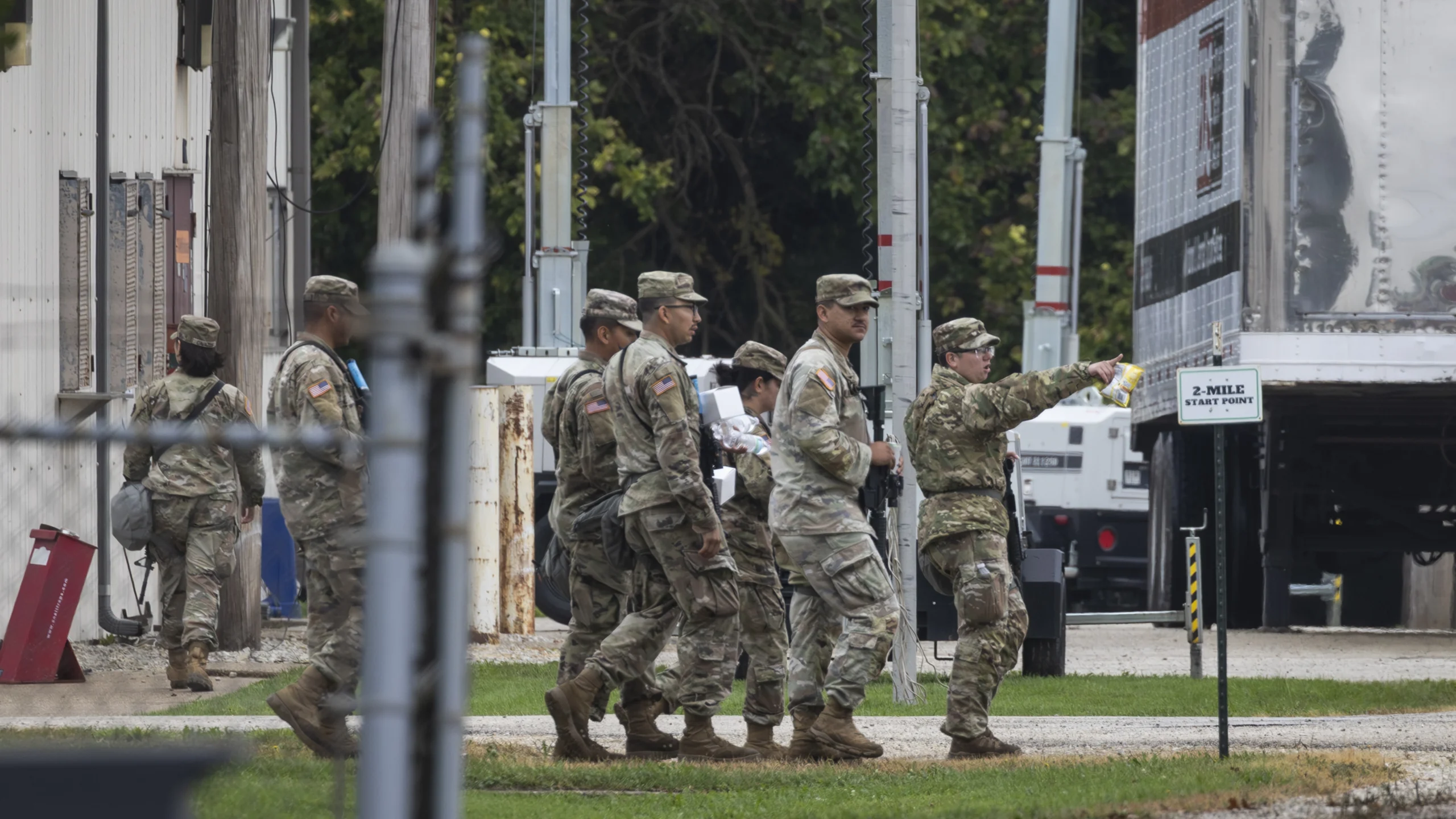
A new wave of political and legal tension has erupted after National Guard troops arrived at an Army Reserve Training Center near Chicago earlier this week. The deployment, reportedly involving units from Texas, comes amid a growing dispute between the White House and Illinois officials over the federal government’s authority to send military personnel into states without local approval.
Witnesses reported seeing convoys of military trucks and trailers entering the U.S. Army Reserve Training Center in Elwood, Illinois, about 50 miles southwest of downtown Chicago. Soldiers wearing Texas National Guard insignia were observed setting up temporary housing, fencing, and communication equipment inside the facility.
According to the Pentagon, the troops were deployed as part of a “Federal Protection Mission” designed to safeguard federal property and personnel following a series of violent protests and threats against federal agencies. Officials say the deployment will last approximately 60 days, with potential extensions depending on “security conditions on the ground.”
However, Illinois leaders have fiercely condemned the move. Governor J.B. Pritzker denounced the deployment as “a blatant violation of state sovereignty,” accusing the administration of bypassing both state authorities and existing legal protocols. Chicago Mayor Brandon Johnson echoed the criticism, calling it “an unlawful and provocative action” that threatens to inflame tensions rather than ease them.
“This is not about security — it’s about control,” Johnson said in a press statement. “Chicago does not need to be militarized.”
Legal experts warn the deployment could face major constitutional challenges. Under the Posse Comitatus Act, active-duty military forces are prohibited from participating in domestic law enforcement activities without congressional authorization. While the National Guard can be federalized under certain conditions, those powers are limited and typically require coordination with state governments.
A federal judge in Illinois declined to issue an emergency injunction to halt the deployment but scheduled a hearing later this week to review the case. If the court rules that the federal government overstepped its authority, the troops could be ordered to withdraw.
Meanwhile, reactions among residents near the Elwood facility are mixed. Some locals say the increased military presence makes them feel safer, while others fear it signals a dangerous precedent for future federal interventions in state affairs.
The deployment also comes at a politically charged moment. President Donald Trump recently threatened to invoke the Insurrection Act, a controversial 19th-century law that allows presidents to deploy the military domestically in cases of “rebellion or obstruction of law.” The arrival of the National Guard near Chicago — a predominantly Democratic city — has intensified speculation about whether such a move could be imminent.
As tensions mount between state and federal officials, the situation in Illinois may become a crucial test of executive authority, state rights, and the balance of power in the United States. For now, all eyes remain on the courts — and on the troops stationed quietly just outside Chicago.
Watch video below :


